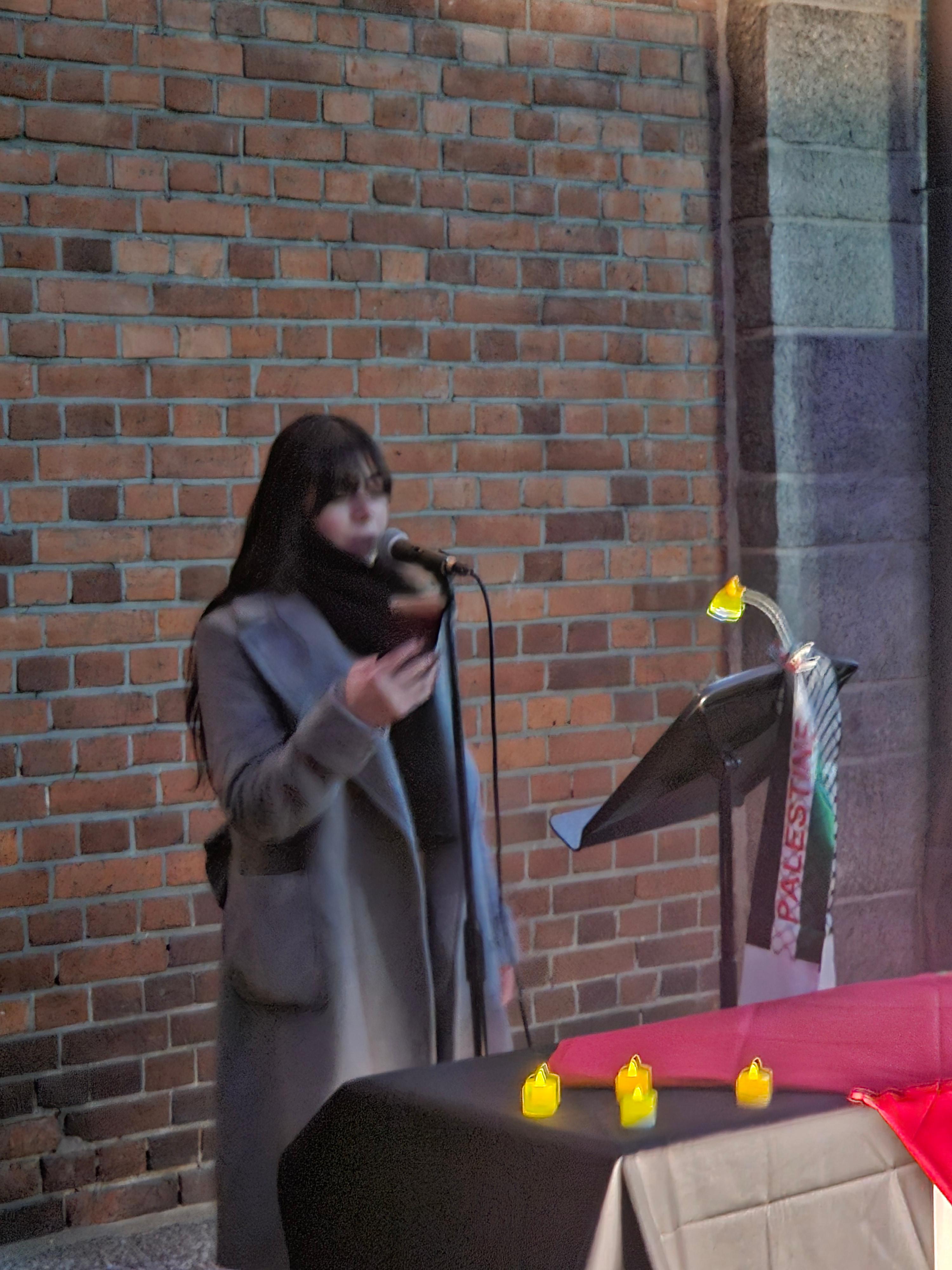

[Testimony]
Ms. Muntaha Abed / Palestine
[Opening]
Grace and peace to you all.
I want to begin by thanking the National Council of Churches in Korea for this invitation and for the steadfast solidarity you have shown toward the Palestinian people. As I stand here in this sacred space, I am deeply moved by the resonance between our faith, our histories of suffering, and our collective yearning for liberation.
When I first read the title of today’s gathering:“The Stones Would Cry Out: Hear the Cries from the Desolate Fields”, I felt an ache of recognition. In Palestine, stones have always spoken. They have witnessed our exile, our endurance, and our unyielding hope. They remember what the world tries to forget.
[From the Land of Stones and Olive Trees]
I come from a land where the soil itself is sacred. Every olive tree holds the memory of generations; of weddings celebrated under their branches, of children who once played in their shade, of ancestors buried nearby. And yet, these same trees are uprooted each year by occupation forces. Homes are demolished, families displaced, and the land made barren in the name of “security.”
As a Palestinian woman, I have lived my whole life between loss and resistance between watching what is destroyed and helping to rebuild what remains. The stones that once paved our roads now mark the ruins of demolished houses.
But they are also the stones that children lift, not merely in defiance, but in testimony, a testimony that we exist, that we remember, that we refuse to be erased.
The verse from Luke reminds us: “If they keep silent, the stones will cry out.”
When the world grows indifferent to our suffering, creation itself carries our story. In Palestine today, the stones are indeed crying out, from Gaza’s shattered streets, from the bulldozed hills of the West Bank, and from the walls that cut through our olive groves.
[Faith and Liberation]
In Christian theology, the Advent season is a time of waiting; a time of yearning for light amidst deep darkness. For Palestinians, Advent is not just a season on the calendar; it is the rhythm of our existence. We wait - not passively, but faithfully - for justice, for return, for peace grounded in equality.
When I think of Bethlehem, the birthplace of Christ, I think of checkpoints that block entry to him, of soldiers surrounding and bombing the Nativity Church in 2002, and of families denied the right to worship in the very place where the Prince of Peace was born. The irony is painful, but it is also prophetic. Because the message of Advent is not comfort without struggle - it is hope born out of resistance. It is light that dares to shine in a world that prefers the shadows of silence.
[Personal Testimony]
The last time I went to visit Jesus Christ on Christmas in Bethlehem was the first time I understood that not all people are treated as equal. After being stopped for hours by the occupation forces at a checkpoint -surrounded by K9 dogs, soldiers’ shouting, and humiliation in the freezing cold -I felt scared and small, but more than anything, I felt deeply sad.
I remember thinking of Jesus, who sacrificed himself for us, who tried to teach humanity that we are all equal before God. I wondered how disappointed he must feel, looking upon his birthplace and seeing what we have become, how little we have learned. Only twenty minutes away from where Jesus once lay in his loneliness and agony, I was being treated as less than human.
Ten years after that night, I found myself speaking again to Jesus and to Mother Mary, asking them many questions. I spent countless nights trying to fall asleep to the sound of missiles and bombs outside my window. I watched my cat hide under the couch each time the earth shook from explosions, and I heard my parents wailing as news arrived of yet another relative lost in Gaza.
I was born there, but I never truly lived there. Displaced to the West Bank when I was three, I never met my grandparents, my aunts, my uncles, or my cousins. I began meeting them only in 2023, as names on obituaries, as fragments of horror in stories my mother could barely tell through her tears.
After losing his son, my uncle told me over the phone: “I recognized him by his teeth. I’m glad I knew how his teeth looked, because everything else was ashes.” And my aunt, it took her two weeks to find words after her son was injured. She said, “He will never walk again. He lost both legs from the thighs down, his insides were torn apart. He will never eat again. How can Ayman not taste my food ever again? What do I do with all the recipes I saved for him now?”
That is how I came to know 128 members of my family; not in life, but in death. I met them through stories, through grief, through verbs that should never be used to describe a human body.
In Palestine, both Muslims and Christians call upon the name of Mary when we are afraid, or desperate, or happy or moved to tears. “Oh Mary, Mother of Light,” we say. These past two years, Mary and her son have not left me. But they have also not answered me. Each night, the three of us — Jesus, Mary, and I — sit together in silence, surrounded by a darkness that feels endless. We do not know what to feel anymore, or what to do with all this sadness and horror that the world has bestowed upon our homeland, our birthplace. And yet, even in this silence, I find traces of faith--faith that refuses to die, even under the rubble.
[Palestine, Korea, and the Spirit of Solidarity]
My journey has taken me from Palestine to South Korea, where I am pursuing my doctoral research at Seoul National University. My work examines student mobilization and gender dynamics; comparing how young people in South Korea and Palestine have historically transformed despair into collective power.
Through this research, I’ve come to see how our struggles, although separated by geography, are profoundly interconnected. The same structures of empire that divide and occupy Palestine once silenced Korean voices during colonization and dictatorship. Yet from those silences, both peoples have learned to rise.
When I walk through Gwangju, I feel echoes of Gaza. When I read testimonies from the 1980s Korean democracy movement, I hear the same language of grief and courage that I grew up hearing in Palestine. Both our peoples know what it means to face tanks with nothing but our voices, and to still believe that truth has a longer memory than violence.
[Call for Solidarity and Peace]
The NCCK has long stood as a moral voice for justice, from the Korean peninsula to the global South. Your prayers, your advocacy, and your witness remind us that Palestine is not forgotten. The stones may cry out, but so do the faithful, those who refuse to look away, who answer the call of conscience.
In 2009, Palestinian Christian leaders issued the Kairos Palestine Document, a confession of faith and a cry of hope in the midst of despair. It reminds the world that true faith is not neutral in the face of oppression. It is an act of love and resistance; a refusal to accept injustice as God’s will. The document declares that our struggle is not against any people or religion, but against the sin of occupation itself, and it calls on churches and believers around the world to stand with the oppressed until justice and peace embrace.
As the Kairos authors wrote, “Our word is a cry of hope, with love, prayer and faith in God.” That cry still echoes today, in every Palestinian church whose bells ring under curfew, in every classroom that continues to teach under siege, in every child who dares to dream of return.
To stand with Palestine, then, is to live out the Kairos spirit, to embody a faith that acts, a theology that liberates, a love that refuses despair. It is to believe, as Kairos Palestine teaches, that peace cannot be built on submission, but only on the restoration of justice and dignity.
Today, as we gather in prayer, let us remember that peace is not the silence of guns - it is the presence of justice. It is not built on occupation, but on equality and freedom. The same God who heard the cries of the oppressed in Exodus still listens today - in Gaza, in Jerusalem, in Seoul, and beyond.
[증언 한글 버전] https://yunheepathos.tistory.com/2786
2025 대림절 기도회에 울린 팔레스타인의 목소리 - "잔해 아래에서조차 죽기를 거부하는 그 신앙"
2025.11.28. 대한성공회 서울주교좌성당 야외광장에서 2025 팔레스타인 평화를 위한 대림절 기도회가 있었습니다. 이 날 아시아의친구들 차미경 선배의 소개로 팔레스타인 가자지구 출신 'Muntaha Abed
yunheepathos.tistory.com
[기도회 관련 자료 (사진/순서지 등) ] https://yunheepathos.tistory.com/2788

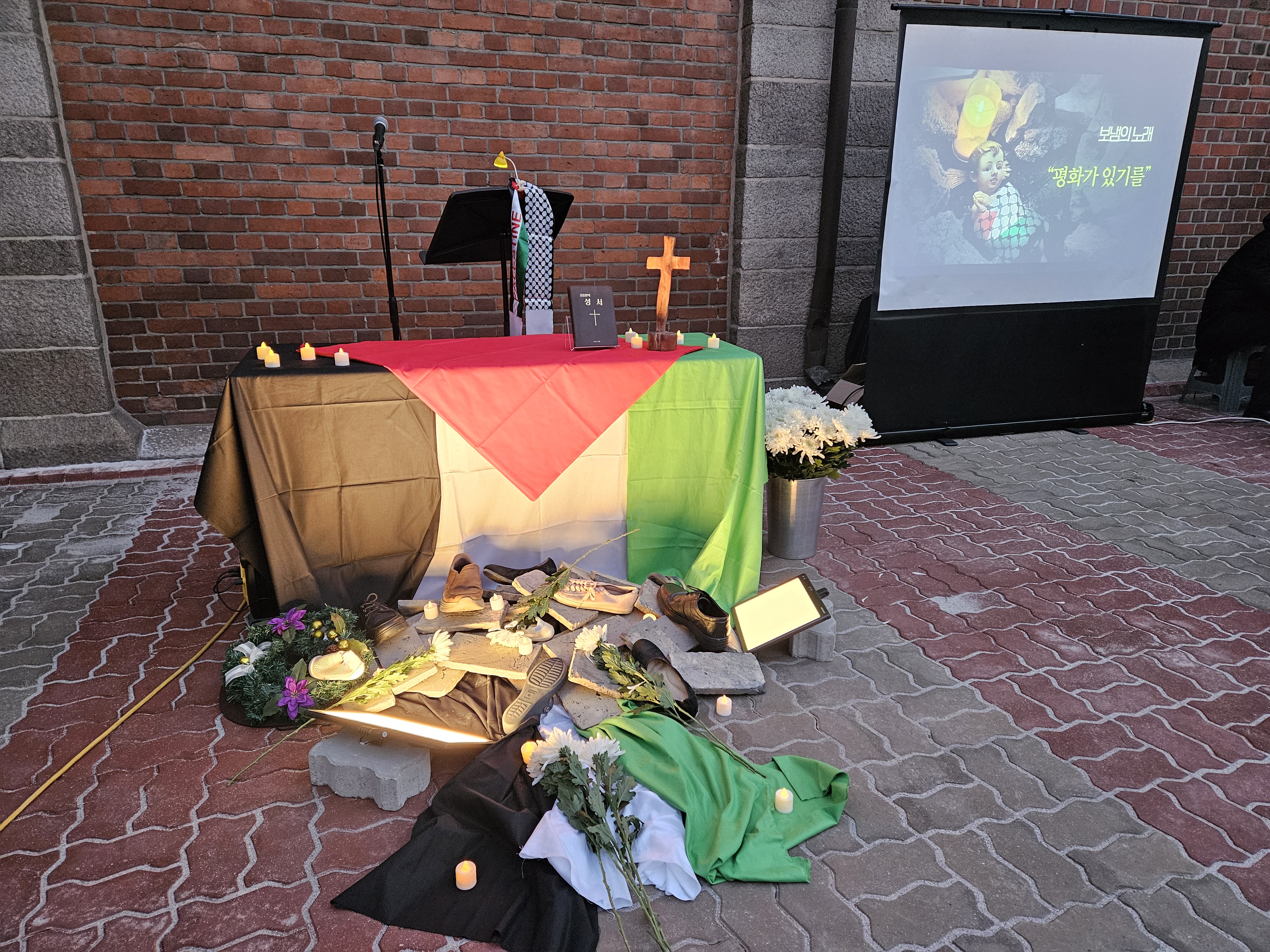


[기도회 전체 영상] https://www.youtube.com/watch?v=BSAmQPCAoAI
'에큐메니컬, YMCA > 에큐메니컬' 카테고리의 다른 글
| '다시 살아난 자들이 부르는 부활의 합창'으로 - NCCK 박승렬 총무의 취임을 축하드립니다. (1) | 2025.12.09 |
|---|---|
| 2025 팔레스타인 평화를 위한 대림절 기도회 관련 자료 (0) | 2025.11.29 |
| 2025 팔레스타인 평화를 위한 대림절 기도회 (1) | 2025.11.27 |
| 김경호 목사님 은퇴식에 참여 (1) | 2025.11.10 |
| <팔레스타인-이스라엘 평화를 위한 한국기독교교회협의회(NCCK) 입장문>을 채택하기 위한 준비 회의 2차 모임. (0) | 2025.10.15 |


